
Quick Summary
Hyper-personalization is one of the most important marketing approaches for 2026.
Instead of sending the same message to every customer, brands can use behavior, context, first-party data, and AI marketing systems to create more relevant experiences.
This approach helps businesses improve engagement, customer loyalty, product recommendations, email performance, and conversion rates.
What Is Hyper-Personalization?
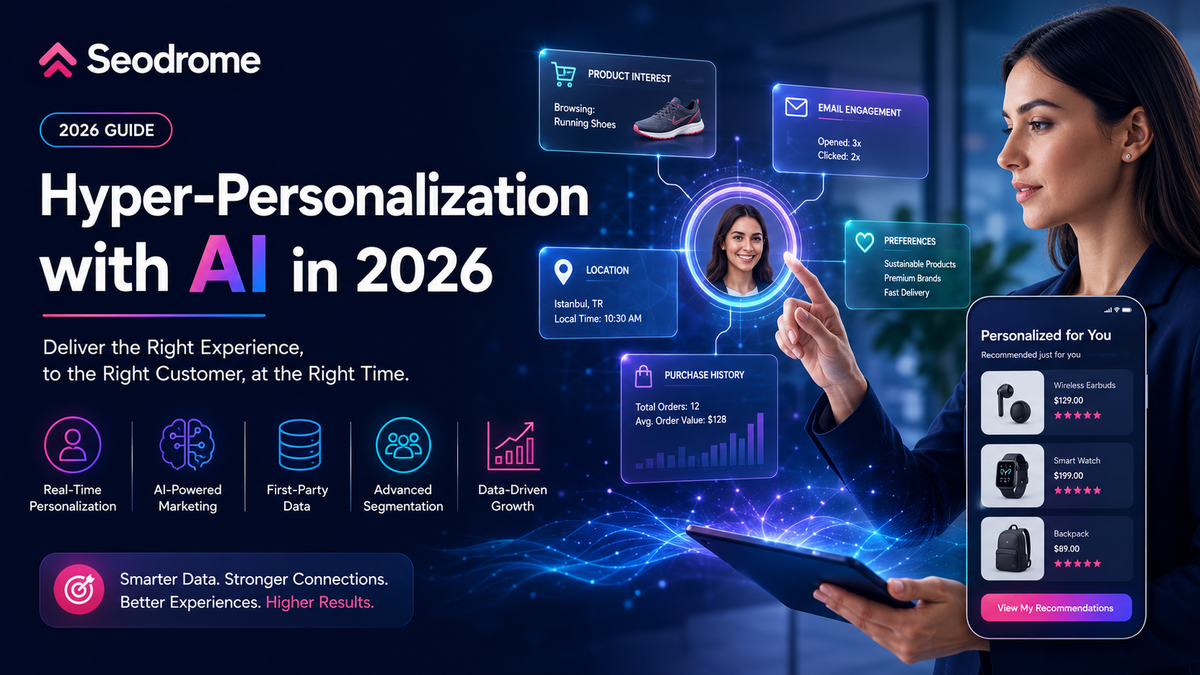
Hyper-personalization is a marketing approach that uses data, artificial intelligence, automation, and real-time customer behavior to create highly relevant experiences for each user.
Traditional personalization may use simple details such as a customer’s name, location, or purchase history.
Hyper-personalization goes deeper.
It considers user behavior, browsing activity, purchase intent, timing, device, preferences, engagement history, and current context.
The goal is to deliver the right message, to the right person, at the right moment.
For example, instead of sending one general email campaign to all subscribers, a brand can send different messages based on what each customer viewed, clicked, purchased, abandoned, or searched for.
This makes marketing more useful for the customer and more effective for the business.
What Is Data-Driven Marketing?
Data-driven marketing means making marketing decisions based on customer data, campaign performance, user behavior, and measurable insights.
It helps brands move away from assumptions.
Instead of guessing what customers want, brands can analyze real behavior and create better experiences.
Data-driven marketing can support:
Customer segmentation
Personalized email marketing
Behavioral targeting
Product recommendations
Content personalization
Retargeting campaigns
Lead scoring
Account profiling
Customer journey optimization
Performance measurement
In 2026, data-driven marketing is not only a technical advantage. It is becoming a core part of modern customer experience.

How AI Marketing Improves Customer Experiences
AI marketing helps brands understand customer behavior faster and respond with more relevant messages.
Artificial intelligence can analyze large amounts of data and find patterns that are difficult to see manually.
For example, AI can help identify which customers are likely to buy, which users may stop engaging, which product a customer may prefer, and which message is more likely to perform.
AI marketing can support:
Predictive product recommendations
Dynamic email content
Personalized website experiences
Customer journey automation
Behavior-based audience segments
Smart ad targeting
Lead scoring
Churn prediction
Real-time offer personalization
This does not mean every decision should be fully automated.
The best AI marketing strategies combine automation with human strategy, brand voice, creative direction, and ethical data use.
The Role of First-Party Data
First-party data is information collected directly from your own customers and audience.
This can include website behavior, purchase history, email engagement, CRM data, form submissions, loyalty program activity, customer preferences, and support interactions.
First-party data is becoming more important because third-party cookies are becoming less reliable.
Brands need stronger direct relationships with their customers.
First-party data helps businesses understand their audience without depending completely on external tracking systems.
Examples of first-party data include:
Products viewed
Items added to cart
Past purchases
Email clicks
Website visits
Form answers
Customer preferences
Loyalty status
Support history
Account activity
When used responsibly, first-party data can make personalization more accurate and more trustworthy.
Customer Segmentation vs Hyper-Personalization
Customer segmentation and hyper-personalization are connected, but they are not the same.
Customer segmentation groups people based on shared characteristics.
For example:
New customers
Returning customers
High-value customers
Inactive subscribers
Cart abandoners
Location-based audiences
Product interest groups
Hyper-personalization goes beyond broad groups.
It creates experiences based on individual behavior and real-time context.
For example, two customers may both be in the “returning customer” segment. But one may be interested in premium products, while the other may be waiting for a discount.
Hyper-personalization helps brands treat them differently.
A strong marketing strategy should use both segmentation and personalization.
Segmentation gives structure. Hyper-personalization adds relevance.

Behavioral Targeting and User Behavior Analysis
Behavioral targeting uses customer actions to create more relevant marketing messages.
Instead of targeting only by age, gender, or location, brands can target users based on what they actually do.
User behavior analysis can include:
Pages visited
Products viewed
Search terms used
Emails opened
Links clicked
Videos watched
Cart activity
Purchase frequency
Time since last order
Content downloaded
Form submissions
This data helps marketers understand intent.
For example, a customer who views the same product three times may need a product comparison, review, or discount reminder.
A user who reads multiple educational articles may need a guide, webinar, or consultation offer.
Behavioral targeting makes marketing more helpful because it responds to the customer’s real journey.
Personalized Email Marketing
Personalized email marketing is one of the most effective uses of hyper-personalization.
Instead of sending the same newsletter to everyone, brands can create different email experiences based on customer behavior.
Personalized email marketing can include:
Product recommendations
Abandoned cart reminders
Browse abandonment emails
Post-purchase follow-ups
Reactivation campaigns
Birthday or loyalty messages
Location-based offers
Dynamic content blocks
Customer lifecycle flows
Personalized subject lines
The goal is not to add the customer’s name to the subject line and call it personalization.
The goal is to make the message relevant.
A strong personalized email should answer this question:
“Why is this message useful for this customer right now?”
Data-Driven Account Profiling
Data-driven account profiling is especially useful for B2B marketing.
It means building a detailed profile of a company or account based on data.
This profile can include company size, industry, website behavior, content interest, decision-maker activity, CRM notes, sales stage, and engagement level.
With this information, marketing and sales teams can create more relevant outreach.
For example, one account may be interested in technical SEO. Another account may be focused on paid ads, content marketing, or conversion optimization.
Data-driven account profiling helps brands personalize communication at the account level.
This is important for account-based marketing, B2B sales, lead nurturing, and enterprise campaigns.
Cookieless Marketing Strategies
Cookieless marketing strategies are becoming more important as brands rely less on third-party cookies.
A cookieless strategy focuses on privacy-friendly data collection, first-party data, contextual targeting, consent-based communication, and stronger customer relationships.
Brands can prepare for cookieless marketing by improving:
First-party data collection
Email list quality
CRM data accuracy
Customer preference centers
Contextual advertising
Server-side tracking
Consent management
Loyalty programs
Content-based targeting
Customer surveys
Cookieless marketing does not mean personalization will disappear.
It means brands must build more direct, transparent, and trustworthy data systems.
The future of personalization depends on trust.

Personalized Product Recommendations
Personalized product recommendations help customers discover products that match their needs, behavior, and interests.
AI can analyze what users viewed, purchased, clicked, saved, or ignored.
Then it can recommend products that are more likely to be relevant.
Product recommendations can appear in:
Product pages
Homepage sections
Cart pages
Checkout pages
Email campaigns
SMS campaigns
Retargeting ads
Mobile apps
Post-purchase flows
Customer dashboards
Good product recommendations should feel helpful, not aggressive.
For example:
Recommended for you
Frequently bought together
Based on your recent views
Complete your setup
You may also like
Best match for your business
Similar products
Upgrade options
Personalized product recommendations can improve average order value, repeat purchases, customer satisfaction, and conversion rate.
Hyper-Personalization Marketing Checklist
Before launching a hyper-personalization campaign, check these points:
The campaign uses real customer behavior.
The data source is clear and reliable.
First-party data is collected with user consent.
Customer segments are meaningful.
AI recommendations are reviewed and tested.
The message is relevant to the customer journey.
Email content is personalized beyond the customer’s name.
Product recommendations match user intent.
Performance tracking is active.
Privacy and trust are respected.
This checklist helps brands create personalization that feels useful, not intrusive.
If your brand wants to build a smarter customer journey, Seodrome can help you create a data-driven marketing strategy powered by AI, first-party data, and customer segmentation.
FAQ
What is hyper-personalization?
Hyper-personalization is a marketing strategy that uses data, AI, automation, and real-time behavior to deliver highly relevant experiences to each customer.
What is the difference between personalization and hyper-personalization?
Personalization often uses basic details like name, location, or purchase history. Hyper-personalization uses deeper behavior, context, intent, and real-time data.
What is data-driven marketing?
Data-driven marketing is the process of using customer data, campaign insights, and performance metrics to make better marketing decisions.
How does AI help with personalization?
AI can analyze customer behavior, predict interests, recommend products, personalize content, automate journeys, and identify high-value customer segments.
What is first-party data?
First-party data is information collected directly from your own audience or customers, such as website behavior, email engagement, purchases, form submissions, and CRM data.
Why is customer segmentation important?
Customer segmentation helps brands group customers based on shared characteristics or behavior. It makes campaigns more organized and relevant.
What is behavioral targeting?
Behavioral targeting uses user actions, such as clicks, views, purchases, and cart activity, to deliver more relevant marketing messages.
What is personalized email marketing?
Personalized email marketing uses customer data to send more relevant emails based on behavior, lifecycle stage, preferences, or purchase history.
What is cookieless marketing?
Cookieless marketing is a strategy that reduces dependence on third-party cookies and focuses on first-party data, consent, contextual targeting, and direct customer relationships.
Are personalized product recommendations useful?
Yes. Personalized product recommendations can improve product discovery, average order value, repeat purchases, and conversion rates when they are relevant and helpful.
Conclusion
Hyper-personalization and data-driven marketing are becoming essential for brands that want to create better customer experiences in 2026.
Customers no longer expect generic campaigns. They expect relevant messages, helpful recommendations, and experiences that match their needs.
AI marketing, first-party data, customer segmentation, behavioral targeting, and personalized email marketing help brands deliver this level of relevance.
The future of marketing is not about sending more messages. It is about sending better messages to the right people at the right time.