
Quick Summary
Video content marketing is becoming more interactive, immersive, and performance-driven in 2026.
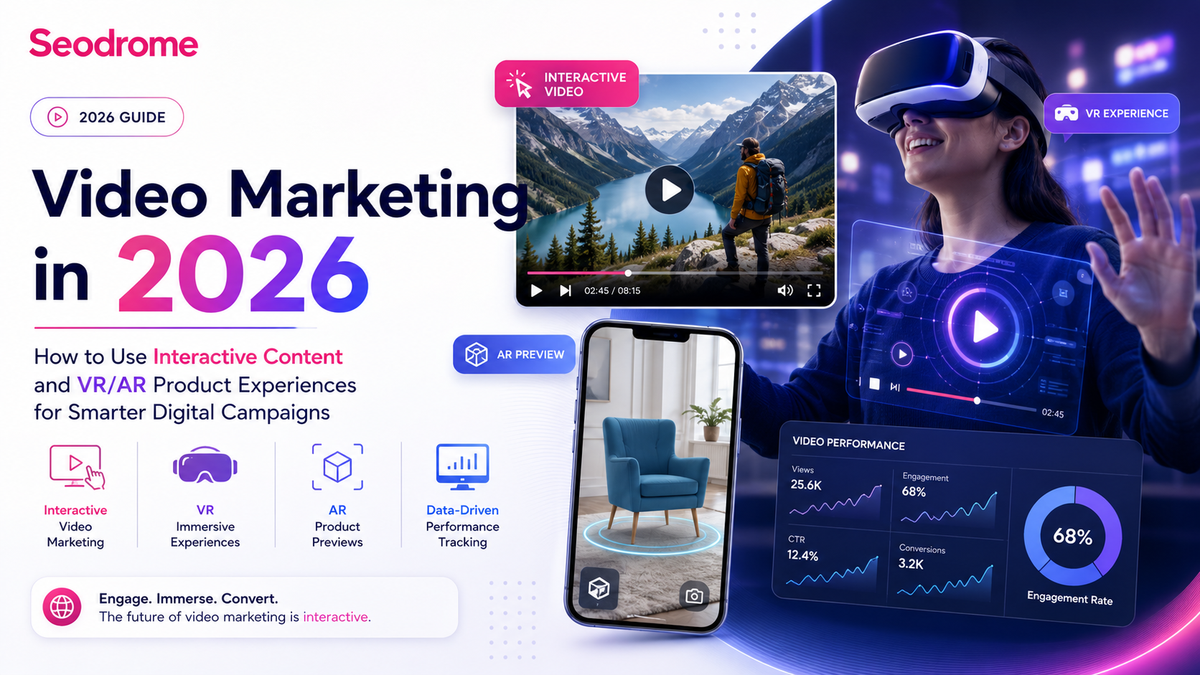
Brands are no longer using video only to explain products. They are using interactive video marketing, VR marketing, AR product experiences, and digital twin product demos to help users explore products before they buy.
This shift makes video a stronger tool for education, engagement, product promotion, and conversion.
What Is Video Content Marketing?
Video content marketing is the use of videos to attract, educate, engage, and convert potential customers.
In 2026, video is not only a brand awareness tool. It is also part of the customer journey. Brands use video to explain products, answer questions, show use cases, compare options, and guide users toward a buying decision.
A strong video content marketing strategy should be clear, helpful, and easy to follow. The video should not only look good. It should answer the viewer’s question and support a specific business goal.
For example, a product video can explain how a product works. A tutorial video can reduce customer support questions. A testimonial video can build trust. An interactive demo can help users explore features before they contact sales.
What Is Interactive Video Marketing?
Interactive video marketing allows viewers to take action inside the video experience.
Instead of only watching, users can click, choose, explore, answer, compare, or move through different content paths.
Interactive video can include:
Clickable product hotspots
In-video questions
Choose-your-path content
Embedded forms
Product comparison points
Shoppable video elements
Lead generation buttons
Chapter navigation
Interactive demo sections
This makes the video experience more personal and more useful.
Interactive video marketing helps brands keep users engaged for longer. It also gives marketers better data about what users care about, where they click, and which products or features attract the most attention.

Why VR and AR Matter in Product Promotion
VR marketing and AR product experiences are becoming more important because users want to understand products before they buy.
Traditional product images and standard videos are useful, but they can be limited. VR and AR make the product experience more immersive.
VR marketing can place the user inside a virtual environment. This is useful for real estate, tourism, automotive, training, events, education, and complex product demonstrations.
AR product experience allows users to view a product in their own environment. This is useful for furniture, fashion, packaging, machines, home products, industrial equipment, and custom products.
For brands, VR/AR supported product promotion can reduce uncertainty. It can help users understand size, shape, function, use case, and value more clearly.
How AR Product Experiences Improve Customer Decisions
An AR product experience helps users visualize a product before purchase.
For example, a customer can see how a piece of furniture looks in a room. A buyer can preview packaging on a shelf. A business customer can explore a machine model from different angles.
This type of experience helps users make better decisions.
AR product experiences can support:
Higher engagement
Better product understanding
Lower purchase hesitation
More confident buying decisions
Stronger product education
More memorable brand interaction
AR does not need to replace traditional product pages. It should support them.
The best product pages combine clear copy, strong visuals, video content, AR previews, technical details, and trust signals.
What Is a Digital Twin in Marketing?
A digital twin is a virtual version of a real product, environment, system, or process.
In marketing, a digital twin can be used to show how a product works before the customer sees or uses the real item.
This is especially useful for complex products.
A digital twin product demo can help users explore product details, test different options, understand workflows, and compare configurations.
For example, a company can create a digital twin of a machine, showroom, packaging system, building, medical device, or production process.
This makes product promotion more visual, interactive, and educational.
Digital twin marketing is powerful because it turns a product presentation into an experience.

How to Create Interactive Demo Marketing Campaigns
Interactive demo marketing helps users understand a product through guided exploration.
A good interactive demo should be simple, focused, and goal-oriented.
The user should not feel lost. Each step should explain one important feature, benefit, or action.
A strong interactive demo campaign can include:
A short intro video
Clickable product features
Step-by-step walkthrough
Use case examples
Comparison sections
CTA buttons
Lead capture forms
Product recommendation logic
Follow-up email automation
The goal is not to show everything at once. The goal is to guide the user toward the most relevant information.
Interactive demo marketing works best when it is connected to a larger campaign. This can include landing pages, email flows, retargeting ads, social media content, and sales follow-up.
Video SEO Strategy for 2026
Video SEO strategy helps your videos become easier to find, understand, and rank.
Search engines and AI systems need context. That means your video should be supported by clear titles, descriptions, transcripts, structured data, and relevant page content.
A strong video SEO strategy should include:
Keyword-focused video title
Clear video description
Transcript or summary
Video schema markup
Relevant page copy
Optimized thumbnail
Fast loading video embed
Internal links
Clear CTA
Engagement tracking
The video should also match the search intent.
If the user wants a tutorial, the video should teach. If the user wants a product comparison, the video should compare. If the user wants a demo, the video should show the product in action.
Good video SEO is not only about ranking the video. It is about making the video useful inside the full content experience.
Video Interaction Points Inside the Content
Video interaction points are clickable or trackable elements inside a video.
They help users take action while watching.
Common video interaction points include:
Product hotspots
Chapter buttons
Clickable CTAs
Polls or questions
Lead forms
Add-to-cart buttons
Feature highlights
Comparison tabs
Download buttons
Schedule-a-demo buttons
These points make video more useful for both the viewer and the marketing team.
For the viewer, they create a more guided experience. For the brand, they create valuable performance data.
You can see which features users click, where they stop watching, which CTA performs best, and which product section creates the most interest.
Video Performance Tracking
Video performance tracking is essential for understanding whether your campaign works.
Views alone are not enough.
A video can have many views but low conversions. Another video can have fewer views but stronger engagement and better sales results.
Important video performance metrics include:
Watch time
Completion rate
Click-through rate
Interaction rate
CTA clicks
Lead form submissions
Product clicks
Conversion rate
Drop-off points
Revenue influenced by video
These metrics help marketers improve future campaigns.
For example, if users stop watching after the first 15 seconds, the intro may be too slow. If users click on one product feature more than others, that feature may need stronger promotion. If a CTA has low clicks, the message or placement may need improvement.
Video performance tracking turns creative content into measurable marketing.
Embed Video Campaign Strategy
An embed video campaign means placing videos inside strategic website pages, landing pages, emails, product pages, blog posts, and sales funnels.
Embedded videos can improve the user experience when they are placed correctly.
A video should support the page content. It should not distract users or slow down the page.
Good places to embed video include:
Product pages
Service pages
Landing pages
Blog articles
Case studies
FAQ sections
Email campaigns
Sales enablement pages
Training pages
Comparison pages
An embedded video should have a clear purpose.
For example, a product page video should explain the product. A landing page video should support conversion. A blog video should explain the topic more clearly. A case study video should build trust.
For SEO, embedded videos should be optimized with titles, captions, descriptions, schema, and relevant surrounding text.
VR/AR Supported Product Promotion Checklist
Before launching a VR or AR product promotion campaign, check these points:
The product experience is easy to understand.
The interaction is useful, not just decorative.
The video or AR experience supports a real user question.
The page has clear written content around the experience.
The CTA is visible and relevant.
The experience works well on mobile devices.
The loading speed is optimized.
The campaign has performance tracking.
The user journey continues after the interaction.
The content supports trust and product education.
This checklist helps brands create immersive experiences that support real marketing goals.
If your brand needs a stronger digital campaign, Seodrome can help you build a video marketing strategy that combines SEO, performance tracking, and interactive content.
CTA Section
Need help building an interactive video marketing strategy?
Seodrome helps brands create smarter digital campaigns with video SEO, interactive content, VR/AR product experiences, and performance-focused marketing systems.
Our team can help you plan, optimize, and measure video campaigns built for modern search, user engagement, and conversion.
Contact Seodrome to build a video marketing strategy for 2026 and beyond.
FAQ
What is video content marketing?
Video content marketing is the use of video to attract, educate, engage, and convert potential customers. It can include product videos, tutorials, demos, testimonials, webinars, and interactive video experiences.
What is interactive video marketing?
Interactive video marketing allows users to click, choose, answer, explore, or take action inside a video. It makes the viewing experience more engaging and measurable.
What is VR marketing?
VR marketing uses virtual reality experiences to place users inside a digital environment. It is useful for immersive product demos, virtual showrooms, training, real estate, tourism, and complex product presentations.
What is an AR product experience?
An AR product experience allows users to view or interact with a digital version of a product in their real environment. It helps customers better understand the product before purchase.
What is a digital twin in marketing?
A digital twin is a virtual version of a real product, system, or environment. In marketing, it can be used to create interactive demos, product previews, and immersive educational experiences.
Why is video SEO important?
Video SEO helps search engines and AI systems understand your video content. It improves discoverability through optimized titles, descriptions, transcripts, schema markup, thumbnails, and relevant page content.
What are video interaction points?
Video interaction points are clickable or trackable elements inside a video. They can include product hotspots, CTA buttons, forms, polls, chapter navigation, and shoppable elements.
How do you track video performance?
Video performance can be tracked through watch time, completion rate, interaction rate, CTA clicks, lead submissions, product clicks, conversion rate, and drop-off points.
Where should videos be embedded?
Videos can be embedded on product pages, landing pages, blog articles, service pages, emails, case studies, FAQ sections, and sales pages. The placement should support the user journey.
Are VR and AR useful for all businesses?
Not every business needs VR or AR. They are most useful when a product is visual, complex, customizable, expensive, or difficult to explain with text and images alone.
Conclusion
Video content marketing in 2026 is more interactive, immersive, and measurable than ever.
Brands are moving beyond standard videos. They are using interactive video marketing, VR marketing, AR product experiences, digital twins, and embedded video campaigns to create stronger product promotion experiences.
A successful strategy should combine creativity with structure. It should include video SEO, clear interaction points, strong page content, performance tracking, and a smooth user journey.
The future of video marketing is not only about being watched. It is about helping users explore, understand, interact, and decide.